
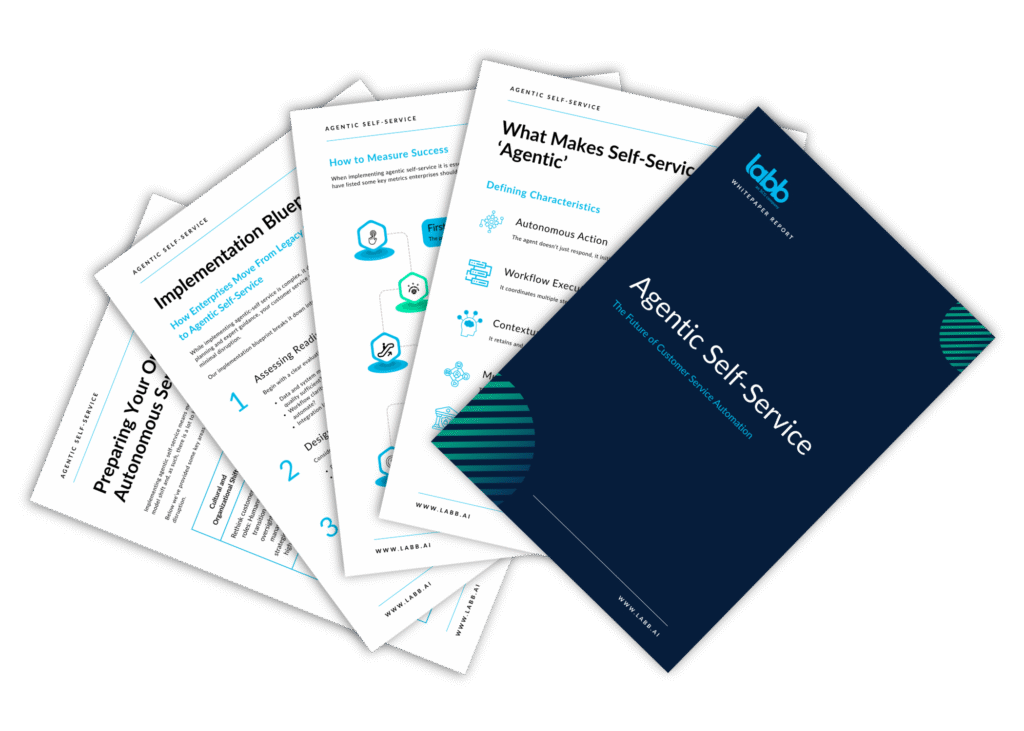
Our latest white paper, Agentic Self-Service: The Future of Customer Service Automation, unpacks agentic AI in the context of customer service, outlining how it can improve your CX – here’s what you can expect
Across industries such as financial services, insurance, telecommunications, and aviation, organizations are under increasing pressure to deliver faster, more efficient customer service while managing rising operational costs. Customer expectations continue to rise, service volumes are growing, and enterprises must balance experience improvements with operational resilience.
For many organizations, self-service has become a central component of this strategy. Digital channels such as portals, chatbots, and automated workflows were introduced to reduce service costs and enable customers to resolve issues independently. While these tools have improved accessibility and reduced some operational pressure, they often fall short of delivering complete outcomes. Customers frequently start interactions in self-service environments only to escalate to human agents to finish the task.
This gap between information and execution has become a defining challenge in modern service operations.
In our Agentic Self-Service white paper, we explore how a new generation of autonomous service models is beginning to close this gap.
Agentic self-service represents the next step in the evolution of digital service. Rather than simply providing answers or directing customers to the right resources, agentic systems are capable of executing workflows autonomously, completing tasks on behalf of the customer across multiple systems and channels.
Importantly, this shift does not replace existing self-service investments. Instead, it builds upon them.
The Evolution of Self-Service
Traditional self-service models focus on providing information. Customers search knowledge bases, navigate digital forms, or interact with chatbots that guide them through predefined scripts. While these tools can resolve simple queries, they rarely complete complex processes end to end.
For example, a customer attempting to update personal details, submit a claim, or change a service plan may still encounter manual steps, fragmented workflows, or repeated requests for information.
As discussed in our white paper, agentic self-service addresses these limitations by combining artificial intelligence with workflow orchestration and enterprise system integration. This enables digital agents to:
- Understand customer intent
- Access relevant data and systems
- Apply business rules and decision logic
- Execute the required actions autonomously
The result is a service experience that moves beyond conversation and actually delivers outcomes.
Business Impact for Enterprise Leaders
For executive teams, the implications of agentic self-service extend beyond technology innovation. When implemented effectively, it reshapes how service operations function across the organization.
As outlined in the white paper, agentic self-service can enable:
Reduced Cost-to-Serve
Autonomous workflows minimize manual handling and reduce the need for escalation to human agents.
Lower Customer Effort
Customers experience faster resolution because tasks are completed within the digital channel rather than passed between systems or teams.
Greater Operational Resilience
Autonomous systems can handle high service volumes consistently and operate continuously across channels.
Improved Governance and Transparency
Enterprise-grade platforms support auditability, decision logging, and oversight models that allow organizations to scale automation safely.
These benefits make agentic self-service attractive not only for customer experience leaders but also for operations, technology, risk, and commercial stakeholders.
Foundations Still Matter
Despite its potential, agentic self-service is not a shortcut to transformation. Organizations that attempt to deploy autonomous capabilities without strong operational foundations often encounter integration challenges, governance concerns, or limited scalability.
As our white paper explains, successful adoption depends on several underlying capabilities:
- Clearly defined workflows and processes
- Reliable and accessible enterprise data
- Integrated systems across the technology landscape
- Governance models that define human oversight and accountability
In this sense, agentic self-service should be viewed as the next stage of self-service maturity, rather than a replacement for existing digital capabilities.
Moving Towards Responsible Adoption
For most enterprises, the transition to agentic self-service occurs incrementally. Organizations typically begin by identifying high-volume workflows that benefit from automation, introducing controlled autonomy through human-in-the-loop oversight, and expanding capabilities as confidence grows.
This approach allows organizations to capture value early while maintaining governance discipline and operational control.
Our white paper explores this journey in greater depth, including practical guidance on evaluating readiness, designing operating models, and scaling agentic self-service across the enterprise.
As enterprises continue to modernize service operations, agentic self-service is emerging as a strategic capability that can improve efficiency, strengthen customer experience, and support scalable service delivery.
The question for leadership teams is no longer whether self-service should evolve, but how organizations can responsibly transition from informational digital channels to autonomous service execution.
To learn more about agentic self-service and find out how you can safely implement this impressive technology, download the white paper Agentic Self-Service: The Future of Customer Service Automation for free today.
Need more advice? Labb’s highly experienced team can work with you to ensure you organization adopts agentic self-service swiftly, safely, and with minimum disruption. Get in touch today to book an impartial chat.